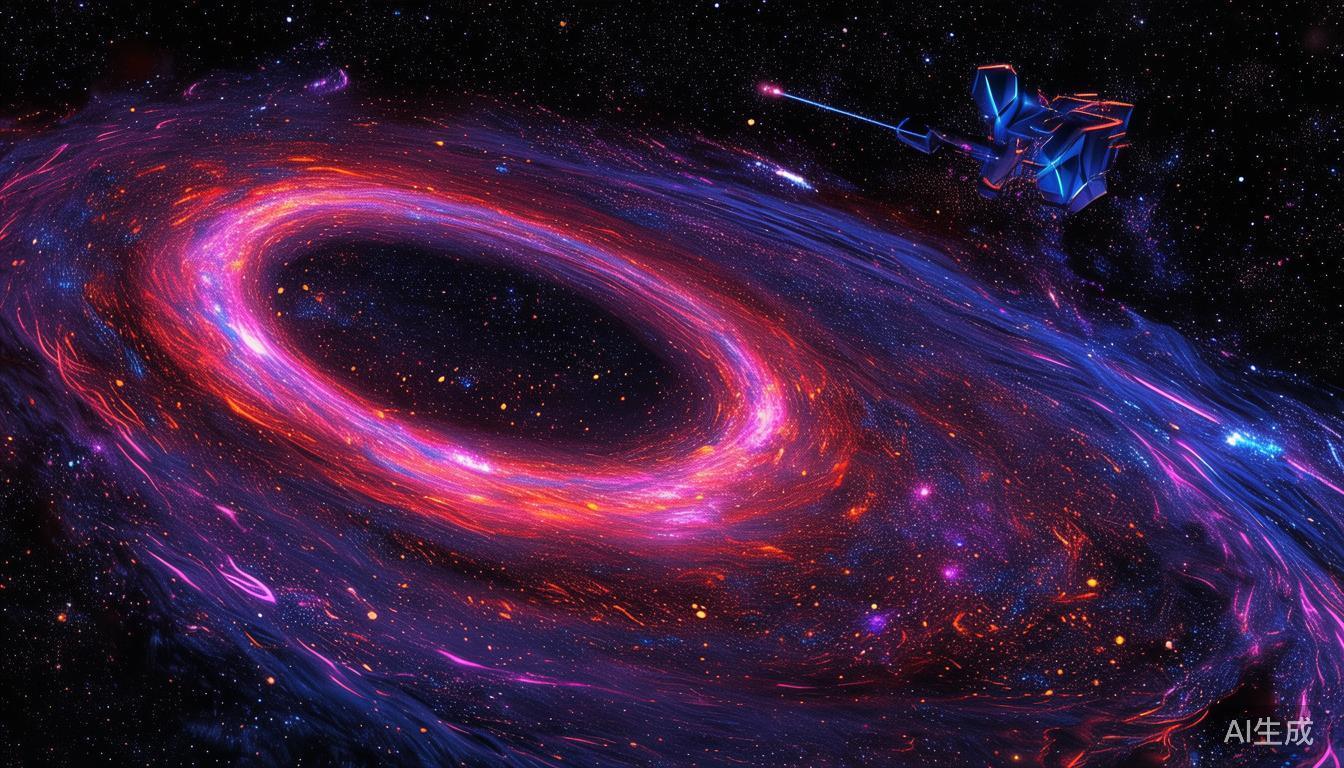
一颗流浪黑洞被捕捉到进食的瞬间
黑洞,这些神秘的宇宙实体,长期以来一直吸引着天文学家和爱好者的想象力。它们巨大的引力能够弯曲光线并吞噬恒星,使其成为宇宙中最引人入胜的天体之一。但当其中一颗这样的庞然大物不再静止——它开始流浪时,又会发生什么呢?最近的观测捕捉到了一颗流浪黑洞正在进食的瞬间,为我们提供了一次罕见的机会,得以窥见宇宙中最动态和最剧烈的事件之一。
流浪黑洞的谜团
黑洞通常位于星系的中心,与它们的主星相互束缚,并以可预测的方式运行。然而,有些黑洞是流浪的,它们在太空中漫无目的地漂移,没有明确的目的地。这些流浪黑洞通常是星系合并或其他引力相互作用将其从原始位置抛出的结果。了解它们的行为对于揭示星系形成和演化的奥秘至关重要。
发现:一颗正在移动的黑洞
最近发现的一颗流浪黑洞正在进食的事件,为我们揭示了这些难以捉摸的天体提供了新的见解。该事件是由一个使用事件视界望远镜(EHT)的天文学家团队观测到的,EHT是一个由望远镜组成的网络,它们结合力量创建了一个虚拟的地球大小的望远镜。这种能力使科学家能够以前所未有的细节观测遥远的奇特天体。
所讨论的黑洞是在从一颗附近的恒星吸积物质的过程中被探测到的。当黑洞吸入气体和尘埃时,它形成了一个吸积盘——一个旋转的涡流状物质,其温度高达数百万度,发出X射线和其他形式的辐射。EHT的观测揭示了该吸积盘的复杂结构,为黑洞的质量、自转以及进食过程的动力学提供了线索。
分析数据
从EHT观测收集到的数据通过复杂的模型进行分析,以了解黑洞的行为。分析的一个关键方面是研究极向喷流,这是一股以接近光速从吸积盘射出的高能粒子流。喷流的特性,如其方向和强度,可以提供有关黑洞自转及其周围磁场的信息。
以下是一个简化的示例,说明天文学家如何模拟吸积盘和喷流:
import numpy as np
import matplotlib.pyplot as plt

# 黑洞参数
M = 10  # 质量,单位为太阳质量
spin = 0.9  # 无量纲自转参数

# 吸积盘特性
r_in = 3 * M  # 内径,单位为史瓦西半径
r_out = 50 * M  # 外径,单位为史瓦西半径

# 计算盘温度和光度
def disk_temperature(r):
    return np.sqrt(M / r) * (1 + spin)

def disk_luminosity(r, T):
    return 4 * np.pi * r**2 * sigma * T**4

# 绘图
radii = np.linspace(r_in, r_out, 100)
temperatures = disk_temperature(radii)
luminosities = disk_luminosity(radii, temperatures)

plt.figure(figsize=(10, 5))
plt.subplot(1, 2, 1)
plt.plot(radii, temperatures, label='盘温度')
plt.xlabel('半径(史瓦西半径)')
plt.ylabel('温度(开尔文)')
plt.legend()

plt.subplot(1, 2, 2)
plt.plot(radii, luminosities, label='盘光度')
plt.xlabel('半径(史瓦西半径)')
plt.ylabel('光度(瓦特)')
plt.legend()

plt.tight_layout()
plt.show()
这段代码展示了如何根据黑洞的质量和自转来模拟吸积盘的温度和光度。通过将观测数据与这类模型进行比较,天文学家可以完善他们对黑洞特性的理解。
对黑洞理解的启示
流浪黑洞正在进食的发现对我们理解这些宇宙巨人有以下几个启示:
-
黑洞多样性:它突出了黑洞行为的多样性,表明并非所有黑洞都局限于星系中心。这一发现可能有助于我们深入了解控制黑洞分布和演化的过程。
-
磁场和喷流:对极向喷流的研究提供了有关磁场在黑洞吸积中作用的重要信息。了解这些场如何影响喷流的形成和传播对于建立全面的黑洞动力学理论至关重要。
-
星系演化:流浪黑洞可能在星系演化中扮演重要角色。它们与恒星和其他黑洞的相互作用可能引发恒星形成或影响星系晕的结构。
这意味着什么
观测到一颗流浪黑洞正在进食的瞬间,证明了宇宙的动态和不断演化的本质。它强调了在天体物理学中持续观测和研究的重要性,因为每一次新发现都揭示了塑造宇宙的神秘而强大的力量。对于天文学家和爱好者来说,这一事件提醒我们宇宙充满了惊喜,通过结合尖端技术与严谨分析,我们可以揭开隐藏在黑洞阴影中的秘密。
要点:这一发现不仅加深了我们对黑洞行为的理解,还突出了重力、磁力和宇宙演化之间复杂的相互作用。随着我们继续探索宇宙,这类发现将为新的理论和技术的出现铺平道路,从而拓展我们的知识边界。
A Wandering Black Hole Caught in the Act of Feeding
Black holes, those enigmatic cosmic entities, have long captivated the imagination of astronomers and enthusiasts alike. Their immense gravitational pull, capable of bending light and devouring stars, makes them one of the most fascinating objects in the universe. But what happens when one of these behemoths doesn't just sit still—it wanders? Recent observations have caught a wandering black hole in the act of feeding, providing a rare glimpse into one of the most dynamic and violent events in the cosmos.
The Mystery of Wandering Black Holes
Black holes are typically found at the centers of galaxies, bound to their host stars and behaving in predictable ways. However, some black holes are nomadic, drifting through space without a clear destination. These rogue black holes are often the result of galactic mergers or other gravitational interactions that eject them from their original locations. Understanding their behavior is crucial for unraveling the mysteries of galaxy formation and evolution.
The Discovery: A Black Hole on the Move
The recent discovery of a wandering black hole caught in the act of feeding has shed new light on these elusive objects. The event was observed by a team of astronomers using the Event Horizon Telescope (EHT), a network of telescopes that combines their powers to create a virtual Earth-sized telescope. This capability allows scientists to observe distant and exotic objects with unprecedented detail.
The black hole in question was detected while it was in the process of accreting matter from a nearby star. As the black hole pulled in gas and dust, it formed an accretion disk—a swirling vortex of material that heats up to millions of degrees, emitting X-rays and other forms of radiation. The EHT's observations revealed the intricate structure of this disk, providing clues about the black hole's mass, spin, and the dynamics of the feeding process.
Analyzing the Data
The data collected from the EHT observations were analyzed using sophisticated models to understand the behavior of the black hole. One key aspect of the analysis was the study of the polar jet, a high-energy stream of particles that shoots out from the accretion disk at nearly the speed of light. The jet's properties, such as its direction and intensity, can provide insights into the black hole's spin and the magnetic fields surrounding it.
Here's a simplified example of how astronomers might model the accretion disk and jet:
import numpy as np
import matplotlib.pyplot as plt

# Parameters for the black hole
M = 10  # Mass in solar masses
spin = 0.9  # Dimensionless spin parameter

# Accretion disk properties
r_in = 3 * M  # Inner radius in Schwarzschild radii
r_out = 50 * M  # Outer radius in Schwarzschild radii

# Calculate disk temperature and luminosity
def disk_temperature(r):
    return np.sqrt(M / r) * (1 + spin)

def disk_luminosity(r, T):
    return 4 * np.pi * r**2 * sigma * T**4

# Plotting
radii = np.linspace(r_in, r_out, 100)
temperatures = disk_temperature(radii)
luminosities = disk_luminosity(radii, temperatures)

plt.figure(figsize=(10, 5))
plt.subplot(1, 2, 1)
plt.plot(radii, temperatures, label='Disk Temperature')
plt.xlabel('Radius (Schwarzschild radii)')
plt.ylabel('Temperature (K)')
plt.legend()

plt.subplot(1, 2, 2)
plt.plot(radii, luminosities, label='Disk Luminosity')
plt.xlabel('Radius (Schwarzschild radii)')
plt.ylabel('Luminosity (W)')
plt.legend()

plt.tight_layout()
plt.show()
This code snippet demonstrates how the temperature and luminosity of the accretion disk can be modeled based on the black hole's mass and spin. By comparing the observed data with such models, astronomers can refine their understanding of the black hole's properties.
Implications for Our Understanding of Black Holes
The discovery of a wandering black hole feeding on the run has several implications for our understanding of these cosmic giants:
-
Black Hole Diversity: It highlights the diversity of black hole behaviors, showing that not all black holes are confined to galactic centers. This finding could lead to new insights into the processes that govern black hole distribution and evolution.
-
Magnetic Fields and Jets: The study of the polar jet provides valuable information about the role of magnetic fields in black hole accretion. Understanding how these fields influence jet formation and propagation is crucial for developing a comprehensive theory of black hole dynamics.
-
Galactic Evolution: Wandering black holes may play a significant role in the evolution of galaxies. Their interactions with stars and other black holes could trigger star formation or influence the structure of galactic halos.
What This Means
The observation of a wandering black hole caught in the act of feeding is a testament to the dynamic and ever-evolving nature of the universe. It underscores the importance of continued观测 and research in astrophysics, as each new discovery reveals more about the mysterious and powerful forces that shape the cosmos. For astronomers and enthusiasts alike, this event serves as a reminder that the universe is full of surprises, and that by combining cutting-edge technology with rigorous analysis, we can uncover the secrets hidden in the shadows of black holes.
Takeaway: This discovery not only deepens our understanding of black hole behavior but also highlights the intricate interplay between gravity, magnetism, and cosmic evolution. As we continue to explore the universe, such findings will pave the way for new theories and technologies that push the boundaries of our knowledge.